Stellar Blade's Hall of Records and design considerations in digital archives
The winning combination of laser swords, sexed-up character designs, and a better-than-it-had-to-be action game helped 2024's Stellar Blade find an audience, and brought developer Shift Up, then better known for mobile games, mainstream success.
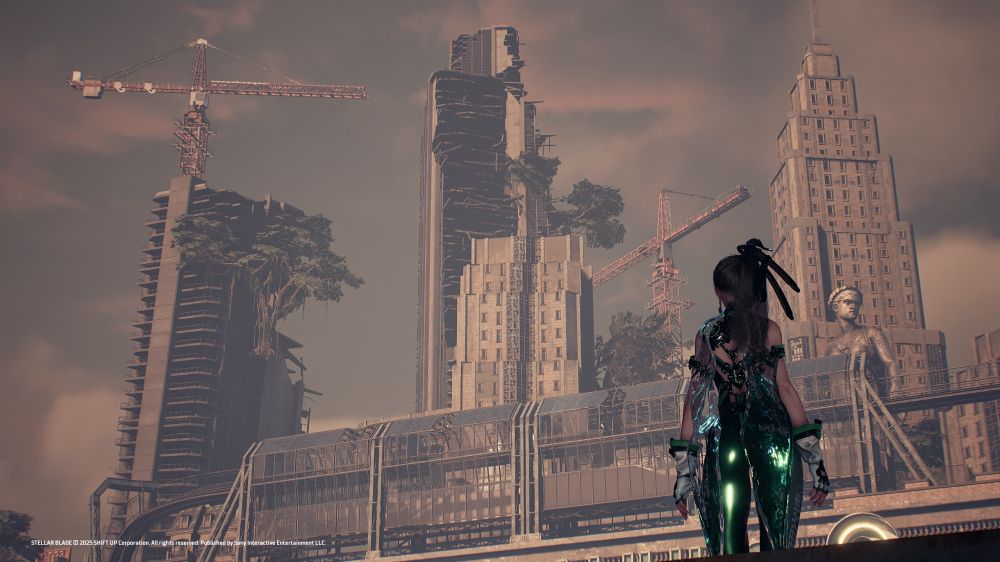
The game follows its protagonist and her allies on a mission to reclaim a ruined earth, and reveals its setting though the digitized "memories" of the people who once lived there. These memories, once recovered, can be uploaded to a massive collection known as Mother Sphere. Which is to say it's basically a game about digital preservation. In that spirit, an early mission sends the hero, Eve, searching for a Hall of Records in a ruined city, to eventually find this structure.

Which is an elevator... to a hallway... to this:

Maybe this isn't the picture in your mind when you hear "archives." But digital preservation is an important, growing area of archival science. Records that have been digitized or were "born digital" --think of emails, database records, or most office documents from the last few decades-- need archiving too. And archivists and the tech industry tend to mean very different things when they say "long-term preservation." So for lots of archives professionals, this isn't too far from reality.
Purpose-built digital archives buildings do exist (I work in one!) and they give archivists and IT professionals space to collaborate. Not everyone has to work in the server room, but they'll definitely spend time there.

So, what do we think of this cavernous room full of ridiculously tall machines? I see a failure to design for people, first and foremost. That happens! It's hard to know who to listen to when you design a facility for digital preservation, so there's some tension between the old guard of "paper" archivists, a younger generation of specialists in digital preservation, and the tech industry. But even the most reliable server room is still a workplace, and there just isn't clear flow, here.
If I'm your network technician, where do I put my backpack? Where do I fill my water bottle? Where's the drawer full of cable adapters and spare keyboards? Does everyone enter and exit through one elevator? Logistically, how would you even replace one of these these building-sized computers?
The high ceilings *could* be the right call, depending on the climate. This sort of space will naturally let warmer air rise above the servers you're trying to cool, which is good. The flipside is that your air conditioning and filtration systems have that much more air to deal with. So, it's cheap when it works and expensive when it doesn't.
The irony is that a lot of the problems of managing data centers—access controls, temperature, and the arrangement of workspace around controlled environments, have been part of archival science for centuries.

This room probably has most of its cabling running under the floor, which is a good solution. Especially if you can't use the ceilings to route cables. But obviously, there are physical access problems, and people have had to work around them. Relatable!
This wiring is totally impractical, too. Spare a thought for the poor IT guy who had to crimp all the connectors.
My biggest criticism, though, is actually that this facility was built underground. It sounds cool, but building in solid ground makes all of your access problems harder. Worse, it makes water intrusion much tougher to deal with. Gravity will always be working against you.
And again, it's a failure to design for people. People need windows! I have colleagues who work in an archives building that was originally built as a bomb shelter. It does things to people.

I especially love this wall of monitors, all crammed together and all showing a message that there's nothing to see. This building is the perfect example of an archives data center gone wrong: hugely over-designed, with no input from the human experts who will actually work there every day. Some architects want to build you a swiss watch, when what you really need is a nineties Toyota: hard to break, easy to work on.
"May your memories live on forever." Couldn't have said it better myself, Eve.